
Population guidance misses individual response
Standard guidelines matter for public health, but they do not explain why two clients can follow the same healthy plan and get very different results.
We use necessary cookies to keep CalorieScience working. Analytics tools, including Google Analytics, Google Tag Manager, Microsoft Clarity, Mixpanel, Meta Pixel, and LinkedIn Insight only load if you allow analytics cookies.
Personalised nutrition platform technology is changing how practitioners deliver nutrition care. Instead of relying on generic recommendations, practitioners can now combine biomarkers, dietary preferences, food data, and clinical insights to create nutrition plans tailored to the individual.
31-day free trial · No credit card required · Cancel anytime · Setup in minutes
800 participants, 46,898 meals
found high variability in glucose response to identical foods
Zeevi et al., Cell, 20157 RCTs, n = 873 (prediabetes & metabolic syndrome)
found precision nutrition interventions consistently improved HbA1c and waist circumference, with mixed results on lipids and blood pressure
Robertson et al., Nutrients, 20243,500+ BANT-registered UK practitioners
applying personalised nutrition in clinical practice
BANT Practitioner RegisterTwo people can follow the same “healthy” plan and get very different results. The issue is not effort; it is that biology, routine, preferences and response patterns rarely fit a static template.
A plan that ignores individual context quickly becomes hard to follow, hard to explain and hard to adapt.
Standard guidelines matter for public health, but they do not explain why two clients can follow the same healthy plan and get very different results.
Food4Me showed personalised online nutrition advice led to more appropriate dietary changes than generic population guidance.
Postprandial glucose studies show substantial variation in blood sugar responses to identical meals, even in people without diabetes.
Personalised nutrition puts the individual's biology, history and lived experience at the centre of care, instead of fitting them into a generic protocol.
UK bodies such as BANT describe personalised nutrition as tailoring recommendations based on symptom patterns, clinical markers, genetics, microbiome, lifestyle and preferences within a structured, evidence-based framework.
On CalorieScience, that means:
Bring nutrition intake, relevant biomarkers, client-provided medications, lifestyle patterns and goals into a single workspace.
Turn assessment data into food and lifestyle strategies shaped around clinical priorities, risk factors and readiness for change.
Use AI-assisted tools to move faster while reviewing, editing and approving the plan before it reaches the client.
The evidence base for personalised nutrition has grown rapidly over the last decade, especially in digital delivery models that combine assessment data with practitioner-led advice.
The current direction of the literature points toward more precise, behaviour-change-oriented interventions when individual context is actually used in the plan.
Randomised controlled trials such as Food4Me showed personalised nutrition advice delivered digitally can improve diet quality beyond generalised advice.
Recent reviews highlight how combining diet, phenotype, microbiota and genetics with decision support can enable more precise interventions.
CalorieScience is built around evidence-based personalisation, data integration and practitioner-guided behaviour change rather than quick-fix meal plans.
Bring together the information you already collect into one secure workspace:
This mirrors how UK Registered Nutritional Therapy Practitioners are encouraged to assess nutritional imbalances using a whole-person view, rather than isolated metrics.
Traditional nutrition analysis software focuses on macronutrients and vitamin/mineral targets, which is essential but often insufficient for nuanced cases. CalorieScience builds on this foundation by helping you:
Using your assessment, you can generate and refine meal plans that:
You remain in full control of the plan; the software simply makes it faster and more consistent to translate complex data into real-world menus.
A personalised meal planning approach is only as strong as the data informing it. The most clinically meaningful inputs fall into four categories, and the combination matters as much as the individual components.
Objective measures help anchor nutrition planning around risk, response and progress.
What this includes
These inputs can add nuance, but they work best when interpreted inside the wider clinical picture.
What this includes
The most clinically elegant plan still fails if it does not fit how the client actually lives.
What this includes
Each input layer interacts with the others. A client's genetic predisposition toward slower saturated fat clearance may be partially offset by a diverse, plant-rich diet and active lifestyle. Their theoretically optimal macronutrient ratio may need substantial adjustment to fit around shift work or family cooking routines. A personalised nutrition platform holds this complexity simultaneously, which no practitioner can do manually at scale across a large caseload.
GDPR and UK data governance: any platform used to process biomarker, genetic, or health data for UK clients must comply with UK GDPR (retained from EU GDPR post-Brexit) and the Data Protection Act 2018. Genetic data is classified as special category data under UK GDPR and requires explicit consent and appropriate safeguards. Practitioners should confirm compliance with their platform provider before collecting this data.
CalorieScience is a UK and EU GDPR compliant (HIPAA in progress) solution that gives you a structured way to record, review and use these inputs without overwhelming your workflow.
The science underpinning personalised nutrition has been understood for some years. The barrier to widespread clinical adoption has been operational: a practitioner with 50 or 100 clients cannot manually cross-reference biomarker data, gut microbiome analysis, genetic inputs, lifestyle constraints, and food preferences to generate, adapt, and update a genuinely tailored plan for each person every few weeks. It requires software.
AI-assisted personalised nutrition platforms address exactly this gap. The Weizmann Institute study demonstrated that a machine learning algorithm integrating multiple individual data streams could accurately predict personalised glycaemic responses to real-life meals, and that a dietary intervention based on these predictions produced measurably better outcomes than standard advice.
Meal planning remains one of the most time-intensive parts of nutrition practice.
Practitioners often balance: clinical requirements, nutrient targets, preferences, health conditions, cultural needs, and adherence challenges. Doing this manually for every client can be difficult to scale.
CalorieScience helps practitioners generate personalised meal plans using structured client information, biomarker insights and practitioner-defined parameters, typically in minutes, compared with the 30–60 minutes many practitioners spend building a fully personalised plan by hand. The result is more time for consultations and less time spent rebuilding plans from scratch.
A personalised plan only creates value when it is followed.
Many practitioners identify adherence, not plan creation, as the biggest challenge in nutrition care. Common barriers include forgetfulness, complexity, lifestyle constraints, lack of follow-up, and poor visibility into progress.
Improving adherence requires structured monitoring, clear communication, behavioural support, and ongoing engagement. This is why modern nutrition platforms increasingly focus on both planning and implementation.
The future of nutrition practice is not about generating more data. It is about making data actionable.
Practitioners need systems that help them understand clients faster, connect biomarkers to nutrition recommendations, deliver personalised meal plans, monitor adherence, and scale care without compromising quality.
CalorieScience was built around this principle: bringing structure to personalised nutrition so practitioners can focus on the work that matters most.
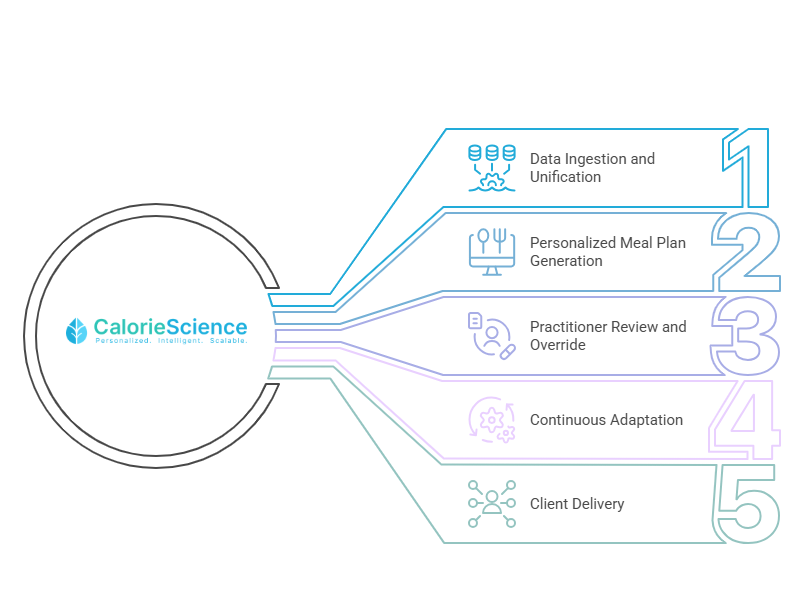
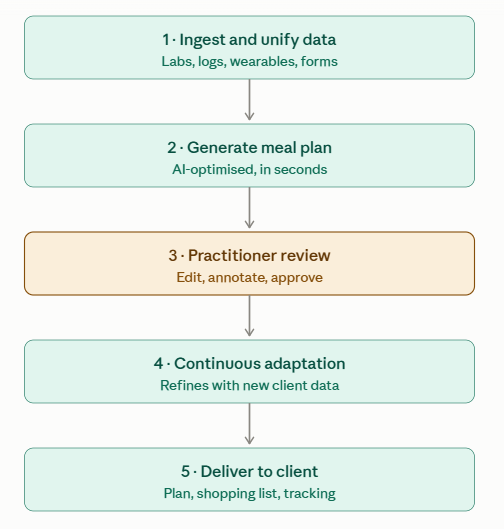
The platform pulls together lab results, lifestyle questionnaires, food logs, activity data, and (where available) genetic or microbiome inputs into a single client profile.
Drawing on that profile and the practitioner’s clinical priorities, the AI generates a meal plan optimised across nutritional targets, preferences, cultural context, and practical constraints — simultaneously, in seconds, versus the 30–60 minutes this typically takes to build by hand.
All AI-generated recommendations are presented to the practitioner for clinical review, annotation, and override before delivery. The platform handles computation; the clinician retains judgement.
As clients log meals and share progress data, the system refines recommendations over time — flagging anomalies or changes in response patterns for practitioner attention.
Final plans reach clients through a branded interface including shopping lists, recipe guidance, and progress tracking — designed to support adherence over the long term.
You decide which suggestions to accept; every recommendation is transparent and editable.
To show how this can work in real life, imagine a composite scenario based on common use cases seen in the literature and UK practice, not an individual case or guaranteed outcome.
Again, this is an example of how the workflow can look, not a promise of specific clinical results.
Most nutrition software used in the UK has historically been built for nutrient analysis, menu management and compliance reporting, for example in healthcare catering, education and sports settings. Practice-management platforms like Practice Better, Healthie and NutriAdmin, and nutrition-analysis tools like Nutrium, cover scheduling, billing and standard meal-plan building well.
| Traditional nutrition analysis software | General practice-management platforms | CalorieScience | |
|---|---|---|---|
| Core focus | Nutrient calculation, menu/label output | Scheduling, billing, client records | Biomarker-informed, personalised care |
| Meal plans | Population-level, template-based | Manual, practitioner-built | AI-generated from client data, practitioner-reviewed |
| Biomarker integration | Not typically included | Not typically included | Built in — blood, vitamin, CGM data |
| Individual-level longitudinal record | Limited | Yes | Yes, combined with biomarker trends |
| AI-assisted interpretation | No | No | Yes, with full practitioner override |
| UK/EU GDPR compliance | Varies by provider | Varies by provider | UK and EU GDPR compliant (HIPAA in progress) |
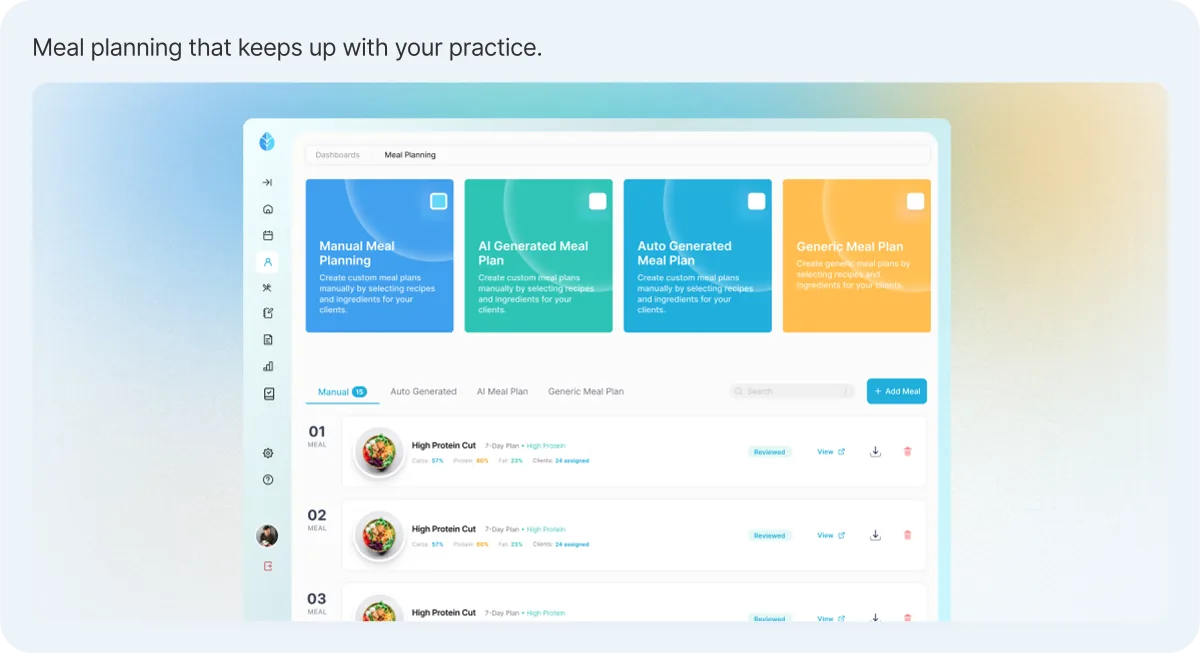
You can still perform core analysis tasks on CalorieScience, but the platform is optimised for one-to-one personalisation grounded in biomarker data, not only population-level menu design or general practice admin.
It's the only piece of software in this space built around a single idea: personalised nutrition backed by real biomarker data, without adding hours of manual work. AI handles the data-crunching; you keep every clinical decision.
CalorieScience is built for UK-based professionals who want to integrate personalised nutrition into everyday practice:
The platform is a professional tool and is not intended to replace medical advice, diagnosis or treatment. Clients should always be advised to consult their GP or specialist regarding medical conditions and medication changes.
Create your practitioner account, add your first client's intake and any available biomarker data, and generate your first AI-assisted, practitioner-reviewed meal plan, typically within your first session.
The AI-assisted, UK/EU GDPR-compliant nutrition platform built for practitioners.
CalorieScience is a workflow and education platform that supports practitioner judgement. It is UK and EU GDPR compliant; HIPAA is in progress. It is not a diagnostic tool, not a medical device, and does not replace clinical assessment by a qualified practitioner.
A personalised nutrition platform helps practitioners create nutrition recommendations based on individual client data such as biomarkers, dietary intake, health conditions and lifestyle factors, rather than generic, population-level advice.